Showing posts with label Wikipedia. Show all posts

Friday, April 26, 2013

Beyond categorization on Wikipedia

[Cross-posted from HASTAC]

There are 508 articles in the category “English women writers” and 30 in the subcategory “English women dramatists and playwrights”. Is that how many writers there actually are? Absolutely not. Am I concerned that not every Wikipedia article is properly tagged? Not really. Why?
Because many articles have not been created that should have been, such as “Mary Cooper (publisher)”, who was one of the first publishers of children’s books in England and many of the articles in those categories have abysmal articles. Let’s take a case in point: Charlotte Lennox. This is a typical biography of a woman writer - it has an unreferenced “Life” section and a “Works” section that consists only of a list. While the article does - surprisingly for Wikipedia - describe the relationship between Lennox’s economic status and how she made her way as a woman writer with some detail, it does not explore the themes and styles of her works at all - a reader will not come away from this article understanding what kind of writer Lennox was. Also, much of Lennox’s life and works are discussed in terms of male writers. While their role is important in her life, Lennox’s own life almost disappears in this article. This article is a good first step for a biography on Wikipedia, but it cannot be left in this incomplete state.

So, what can you do to improve articles like this on authors on Wikipedia?

  • Create a list of reliable sources that can be used to write a good encyclopedia entry and put it on the talk page of the article (you can get to the talk page by clicking on the word “talk” in the top left of the wikipedia window - this is where editors go to discuss what information will be in an article)
  • Add sections to an article to help give it structure
  • Add paragraphs with relevant material (with citations to reliable sources)
  • Draw up an outline of what an ideal article would look like and put it on the talk page (for examples of well-written and well-structured author articles, see Mary Shelley, Maya Angelou, Emily Dickinson)
  • Add images (images must be your own, public domain, or CC-by-SA)
  • Add a complete list of the author’s works
  • Remove spurious information
  • Reorganize information so that it is more coherent
  • Copyedit

Categories are one way we structure knowledge and are important, but the knowledge has to be there to be structured first. Help us shape the world’s knowledge - join Wikipedia! You can start today. Women around the world are making efforts to counter Wikipedia’s systemic bias by writing global women into Wikipedia!

Wednesday, April 17, 2013

Wikipedia is pushing the boundaries of scholarly practice but the gender gap must be addressed

[Cross-posted from Impact of Social Sciences]
 
Wikipedia is the largest reference work the world has ever created. It is the sixth-largest website in the world. It is the most visited reference work on the internet. It is available in over 285 languages. If you want to affect how the world understands a particular topic, you must edit Wikipedia.
As academics, we already possess many of the skills necessary to be excellent writers of encyclopedia entries: specialized knowledge and finely-honed research and writing abilities. It is incumbent upon us to share our knowledge with the world, where it will be read not only by our fellow academics but by anyone curious about our topics.

The gender gap: every edit is political

Wikipedia bills itself as “the free encyclopedia and anyone can edit” – but not everyone does. Approximately 90% of Wikipedia’s editors are male. For Wikipedia, this has resulted in problems of bias, overrepresentation/underrepresentation of topics, and an environment hostile towards female editors. A lack of diversity amongst editors means that, for example, topics typically associated with femininity are underrepresented and often actively deleted. In one publicly reported example, an article about Kate Middleton’s wedding dress was deleted. This is part of a larger trend. WikiProjects, which organize Wikipedia’s content around topics to mobilize its editors, show the level of interest in a topic. The most organized and successful WikiProject is Military History while projects like Textile Arts languish. In many ways, Wikipedia suffers from the same exclusionary problems of the Encyclopédie of old.

Every edit on Wikipedia is political. While Wikipedians pride themselves on remaining objective and neutral, it is impossible to remain so and the presentation of contemporary events puts this into high relief. In February 2012, Sandra Fluke testified before Congressional Democrats about women’s reproductive rights, for which she was viciously attacked by Rush Limbaugh. Within four days of her testimony, a Wikipedia article was created for her. This is one of Wikipedia’s strengths – its ability to be up-to-date. However, within five minutes of being created, the article was nominated for “speedy deletion” for “no indication of importance” (this process allows Wikipedians to delete obvious spam articles). It remained an article, passing this test, but was nominated two hours later through a more rigorous deletion process, in which Wikipedians would debate the merits of the article for a week. Fluke was considered non-notable or notable only because Rush Limbaugh had attacked her. In the end, her biographical article was merged with the Rush Limbaugh-Sandra Fluke controversy article. For three and a half months on Google, the first Google hit for Sandra Fluke’s name was Wikipedia’s article on the controversy. At that time, the Sandra Fluke article was recreated and she was deemed notable enough to have her own article.
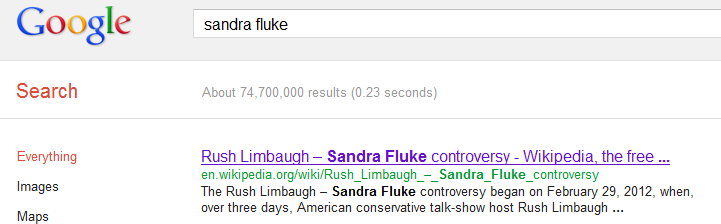


Wikipedia’s rules are not neutral or objective, however much Wikipedians may wish them to be – they have very real political consequences. For three and a half months, Wikipedia allowed Sandra Fluke to be defined by Rush Limbaugh’s wildly inappropriate and derogatory comments, rather than by her own life story, and helped fuel an irrelevant news story. This is one small example of how every choice Wikipedia editors make on the encyclopedia shapes the world’s knowledge and thus who is editing the encyclopedia is of paramount importance.

The gender gap and its concomitant effect on the content and structure of the encyclopedia has caused a recent upsurge in efforts to recruit more women to edit Wikipedia. The Wikimedia Foundation, for example, hired a fellow specifically to work on this problem for a year. But there have also been grassroots efforts and the #tooFEW edit-a-thon on March 15 was part of this. During this event, the THATCamp Feminisms West, East, and South hosted edit-a-thons. Moreover, as news of the edit-a-thon spread, other locations (mainly in the United States) started their own editing sessions and individuals made time in their day to add to Wikipedia’s coverage of women.

The root of all knowledge

During the edit-a-thon, the question of notability and verifiability was raised frequently. Wikipedia has a “notability” policy that determines who and what can have an article. While Wikipedia includes articles about many more topics than a traditional encyclopedia, it does not include articles about any topic. Over the years, Wikipedia’s notability guideline has evolved quite a bit. Wikipedia did not have a solid notability guide until 2007. This is important to remember – Wikipedia’s policies, like everything on the site, evolves and changes as the community changes (if you want to follow the changes, click on the “view history” tab at the top of the page). In general, a topic is notable if it has been covered in reliable sources independent of the subject. What this means in practice, of course, is that Wikipedia should be fundamentally conservative in the sense that it is only publishing information that has been published before. However, because Wikipedia accepts a variety of reliable sources (while still privileging peer-reviewed sources), such as newspapers and blog posts, there are ways in which the encyclopedia is pushing against the boundaries of established scholarly practice.

While academics may see Wikipedia’s rules as restrictive and prescriptive (and in certain contexts they certainly can be), Wikipedians themselves are constantly working to adjust the rules. For example, at Wikimania 2012 (the conference for all things Wikipedia), there was a panel on “Wikipedia in the Twitter Age”, which specifically raised the question of the reliability of different kinds of information and which forms Wikipedia privileges and why, using the 2011 Egyptian revolution as an example of when the most reliable information came from Twitter.

There is nothing more essential than seeing that these policies on Wikipedia are evolving and that if we as feminists and academics want them to evolve in ways we feel reflect the progressive politics important to us, we must participate in the conversation. Wikipedia is a community and we have to join it.

Join us!

Those of participating in the #tooFEW edit-a-thon ended the afternoon by discussing how one could be a feminist activist on Wikipedia. Our ideas included everything from adding content on women to reviewing articles other Wikipedians have written to helping shape guidelines for WikiProjects to using Wikipedia in the classroom.
What Wikipedia chooses to include is shaping what we remember and value about our culture. It is important that as academics we do not absent ourselves from these debates. Wikipedia, like the Encyclopédie, will define what knowledge is for generations. Join us in shaping the world’s knowledge!

Monday, April 15, 2013

Professional Development in Pasadena - Workshops & Tours sponsored by the Art Libraries Society of North America


The Art Libraries Society of North America (ARLIS/NA) will hold its 41st annual conference in Pasadena, California, April 25-29, 2013.
WE ARE PLEASED TO ANNOUNCE THAT SELECT WORKSHOPS AND TOURS ARE BEING MADE AVAILABLE TO OUR LOCAL LIBRARIAN AND PROFESSIONAL COLLEAGUES, AS WELL AS LIBRARY SCHOOL STUDENTS, WHO WILL NOT BE ATTENDING THE CONFERENCE.
Consider taking advantage of this unique opportunity for professional development and register for one (or more!) of the following workshops and tours:

Workshop: The Art of GLAM-Wiki: The Basics of Sharing Cultural Knowledge with the World on Wikipedia 
Friday, April 26, 2013, 8:00am-12:00pm 
Learn how your organization can share its cultural heritage content with a diverse audience on the world's fifth most popular website! Instructors well-versed in the Galleries, Libraries, Archives, Museums with Wikipedia (GLAM-Wiki) Initiative will teach you how to engage with Wikipedia and the Wikipedia community, the basics of GLAM-Wiki, Wikipedia's policies and procedures, and basic editing skills.

Workshop: Postcards from the Edge VI: Television & Media Industries 
Friday, April 26, 2013, 9:00am-12:30pm 
This hands-on workshop format provides practical training for reference and research librarians. The origins and nature of television and media studies will be discussed and participants will be introduced to the most important and useful resources related to the Television and Media industries; special trial access to a number of electronic resources will be provided.

Workshop: Omeka: Creating and Sharing Collections With An Open Source Web Publishing Tool 
Friday, April 26, 2013, 8:00am-12:00pm 
Do you have an exhibition idea or a hidden collection that needs exposure? Come learn the basics of Omeka, a free, flexible, and open source web-publishing platform for the online exhibition and display of library, museum, and archival collections. In this hands-on format you will create your own project with images, audio, video, and texts.

Workshop: Hands-on Letterpress Broadside Printing Workshop at Art Center’s Archetype Press 
Monday, April 29, 2013, 9:00am-1:00pm 
Experience the letterpress renaissance and plan to get hands-on in this participatory workshop where you will print a broadside and be exposed to the cultural history and heritage of typography and print culture. This is a rare opportunity to view and handle the largest collection of American and European metal foundry type, wood type and ornaments in California.

Tour: Los Angeles County Museum of Art and Watts Towers 
Thursday, April 25, 2013, 9:00am-5:00pm 
Experience a one-hour tour of the Stanley Kubrick exhibition led by a LACMA curator, plus a presentation on the conservation challenges presented by the iconic Watts Towers from LACMA’s senior conservation scientist. You’ll have plenty of time to explore the museum before you continue on to a docent led tour at Watts Towers.

Tour: Exploring El Pueblo de Los Angeles Historical Monument: Siqueiros Mural, Avila Adobe, Olvera Street 
Friday, April 26, 2013, 9:00am-1:00pm 
Tour the Avila Adobe (1818), the oldest standing residence in L.A., followed by a visit to the only David Alfaro Siqueiros public mural in the U.S., América Tropical (1932). Leslie Rainer, Senior Project Specialist from the Getty Conservation Institute will give an informative and detailed overview of the mural and talk about the challenges and process of its recent restoration.

Tour: The Getty Villa 
Monday, April 29, 2013, 8:30am-5:30pm 
The day will include a private tour of the Getty Villa, including a curator-led tour of the special exhibition, Sicily: Art and Invention between Greece and Rome. The second part of the day will include a behind-the-scenes tour with an Education Specialist who will talk about the highlights and history of the Villa, including the architecture, the garden, and the renovated Ranch House, which was the original residence of J. Paul Getty.

PLEASE NOTE: Colleagues and students who take advantage of this special opportunity will pay the regular price of the workshop or tour as listed in the program, plus a $15 administrative fee.

For more information, visit the conference website, conference schedule, or our Facebook page. 

AND REGISTER HERE! WE LOOK FORWARD TO WELCOMING YOU! 

Sincerely, Conference Program Co-chairs
Sarah Sherman & Cathy Billings

Sarah Sherman
Reference Librarian
 Getty Research Institute
1200 Getty Center Drive
Los Angeles, CA 90049
www.getty.edu/research